AI for Drug Discovery
A one-year program designed around an end-to-end pipeline: from biological rationale and experimental data, to molecular modeling and AI methods for design and optimization.
Next lesson 27 March 2026 at 16:30 Professor Piotto will lead Module 1, Section 1.1
Following lesson Professor Belvedere will lead Module 1, Section 1.4

At a glance
Navigation
Master overview
What it is, how it is structured, and what participants deliver.
Train professionals who can integrate pharmaceutical sciences and AI: data curation, modeling, prediction, and decision support across the R&D cycle.
Project portfolio, technical reports, final presentation, and a thesis / project work co-supervised by academia or industry (Bayer).
Venues
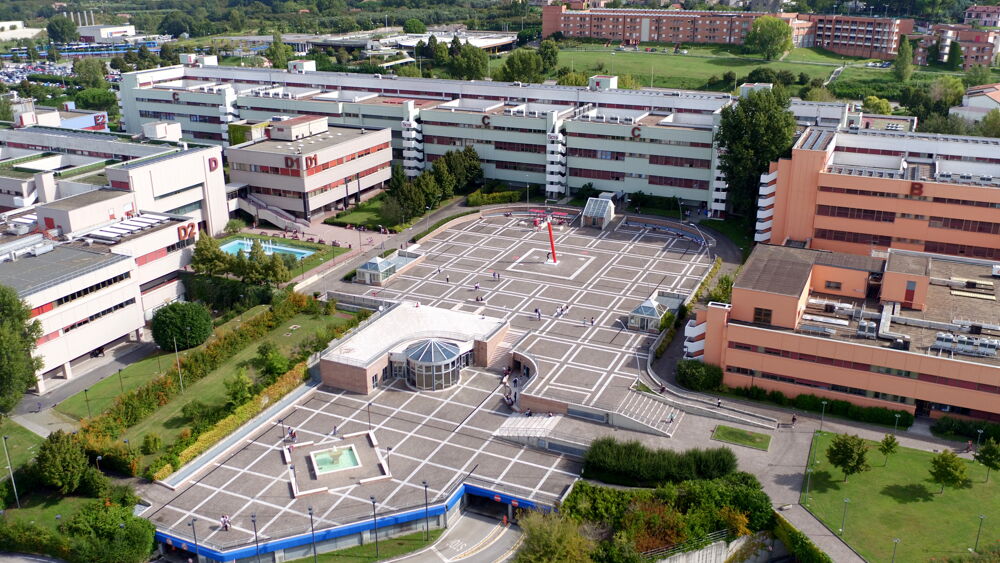
- University of Salerno (DIFARMA) — main venue.
- Industry workshop — (Bayer, SoftMining, Tolemaica).
- All lectures will be streamed.
Who it is for
- MSc graduates (or equivalent) in scientific disciplines (pharmacy, chemistry, biology, computer science, physics, etc.).
- Researchers and technical profiles aiming at AI/cheminformatics/structural bioinformatics roles.
Why this Master
End-to-end pipeline
A modular curriculum covering biology/repurposing, statistics and computational methods, simulation, and advanced AI for discovery.
Hands-on with real constraints
Projects on realistic datasets.
Industry exposure
Workshops and invited talks with industrial partners, focused on use-cases, KPIs, and deployment considerations.
Curriculum
Module 1 — Fundamentals of Drug Discovery
Core concepts and constraints of modern drug discovery, including medicinal chemistry principles and ADME/PK basics.
Module 2 — AI for Drug Repurposing
Data-driven repurposing strategies: biological priors, networks, omics integration, evidence scoring, and candidate ranking.
Module 3 — Statistics & Computational Methods
Statistics, preprocessing, classical ML, validation strategies, and performance metrics, with a focus on reproducible experimentation.
Module 4 — Molecular Modeling & Simulation
Docking, scoring, molecular dynamics, and QM/MM: how to build, run, and interpret structure-based workflows.
Module 5 — Advanced Topics
Advanced AI for molecules: deep learning, GNNs, generative models, uncertainty, interpretability, and model governance.
Module 6 — Industrial & Applied
Industrial use-cases, documentation, transferability, and result communication, including best practices for applied R&D.
Structure & workload
Key numbers and assessment logic.
Teaching
- 300 hours of lectures (blended).
- Self-study reading, assignments, project work.
Internship
- 175 hours of curricular internship.
- Supervision: academic + industry.
Assessment
Module-based evaluations plus a final project/thesis with presentation and discussion.
Admissions
Eligibility, selection, tuition: concise format.
Eligibility
- MSc degree (or equivalent) in a scientific field (Chemistry, Biology, CTF, Computer Science).
- English proficiency (B2 level or above).
Selection & tuition
- If applications exceed available seats: 60% credentials + 40% interview.
- Seats: 10–25.
- Tuition: €3,000 (annual).
Partners & faculty





Faculty (Comitato Tecnico Scientifico)
- Program Director: Prof. Stefano Piotto.
- Simona Concilio // Chemistry
- Carmine Ostacolo // Medicinal Chemistry
- Antonello Petrella // Pharmacology
- Amalia Porta // Microbiology
- Lucia Sessa // Structural Bioinformatics
- Luigi Di Biasi // Coding
Request info / Apply
Contact form
Loading form…
Contacts